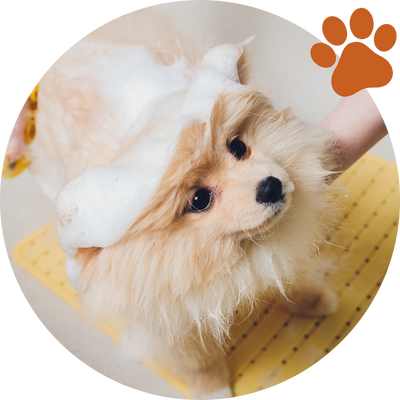
How to choose a dog shampoo ?



Choosing a dog shampoo is not as easy as it seems. And yet, it is essential for your dog’s well-being to wash your dog, protect its skin, respect its coat, and enjoy that little moment of post-bath madness that we love so much. Using the wrong product can cause your dog to scratch, sometimes until they bleed, or their coat to become dull over time. For this reason, Les Wouf advocates a conscious approach to dog bathing. So let’s learn together how to choose a dog shampoo.
Not all coats are the same, and neither are shampoos
A poodle, a boxer, and an Australian shepherd don’t have much in common. While they may be of the same species, often greedy and fond of walks, their coats and skin are very different. The same goes for their shampoo.
The type of coat determines the needs: long hair retains more dust and tangles more easily. Its favorite shampoo is therefore nourishing and detangling. Conversely, short hair, which dries out more quickly, prefers a moisturizing formula. Dogs with undercoats, such as huskies and border collies, need a product that cleanses deeply without weighing down their fur.
But it’s not just a question of coat type. Some dogs have sensitive skin, scratch easily, or produce more sebum. Choosing the right shampoo for your dog means preserving the natural protective barrier of their skin.
In short, there is no such thing as a “universal shampoo” at Les Wouf. Instead, we offer products designed for each type of dog, including a gentle shampoo, an anti-odor shampoo, and a 3-in-1 shampoo that detangles, nourishes, and adds shine to the coat.
Ingredients, pH, promises: what shampoo labels say
Dog care product labels make many promises: “ultimate shine,” “silky effect,” “long-lasting fragrance”… but few clearly mention the ingredients used to achieve these results.
A good dog shampoo should have a suitable pH level, between 6.2 and 7.4 depending on the breed and coat color. It should be free from sulfates (sodium lauryl sulfate, sodium laureth sulfate), silicones (dimethicone, cyclopentasiloxane, etc.), parabens, formaldehyde, and essential oils, which are poorly tolerated by dogs. Ideally, it should also be formulated using natural ingredients. This ensures effective cleaning without damaging the skin.
Also, avoid products that are overly perfumed (unspecified fragrances, Limonene, Linalool, non-natural Citronellol, etc.) or full of unpronounceable chemical compounds. And remember, the best shampoo is not the one that lathers the most, but the one that respects the coat and skin.
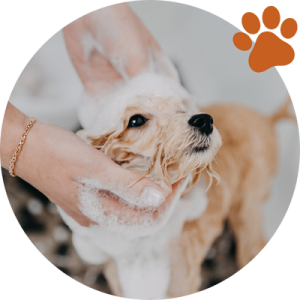
Natural, soothing, flea-repellent… how to choose a shampoo according to your dog’s needs?
To find the right shampoo for your dog, consider their lifestyle and skin type. A dog that sleeps a lot does not have the same hygiene needs as a mountain or forest dog. And a puppy does not wash like an adult with a well-established coat.
A gentle, moisturizing shampoo is suitable for most dogs. It is the ideal choice for regular grooming (3 or 4 times a year maximum).
For dogs prone to itching or redness, choose a soothing formula enriched with aloe vera, calendula, or oats, which calms irritation without making the coat greasy.
If your dog often walks in the forest or is around other animals, an anti-parasite shampoo may be useful, but be careful, it should not be used systematically and is not a substitute for veterinary treatment.
And for puppies? Choose a special formula for young dogs, without strong fragrances or overly powerful cleansing agents. Because their skin is thinner and more permeable, it needs gentleness above all else.
The right shampoo is also one that your dog tolerates.
No shampoo is truly suitable for all dogs. So, before adopting a new product, test it on a small area of the coat if possible: behind the ear or on the side. If the skin remains calm, that’s a good sign.
And above all, always rinse thoroughly after washing. Even shampoo with a healthy formula can cause itching or dandruff if it is not rinsed out completely.
Finally, the frequency of bathing plays a key role. Washing too often removes the protective layer from the coat and makes it more vulnerable. It is better to give your dog a thorough bath after a spa-like treatment than to give them a quick wash every week.
And don’t forget to observe your dog. If their coat is limp, if they scratch themselves or if they categorically refuse to take a bath, their shampoo may not be the right one.